As the climate emergency forces major nations to rethink their carbon emission strategies, a new battle is raging over resources intended to replace oil. Among them is cobalt, a mineral essential for battery production, at the heart of the race to electrify the automotive industry. For now, this competition is largely dominated by
China . The Middle Kingdom has taken advantage of the opening created by years of American policies favoring internal combustion engine vehicles. Today, Washington’s priorities have changed—but is it too late?
The New York Times investigated the struggle between China and the United States over land in the Democratic Republic of Congo to gain control of the largest share of the world’s cobalt resources. At the expense of the local population, of course.
Cobalt: the new black gold
One of the main applications of cobalt today is in the manufacture of rechargeable batteries of all kinds. Cobalt improves the performance of batteries in smartphones, connected devices, and laptops, and plays a significant role in electric vehicles. With this resource being finite and the needs of the technology industries exploding, the Worldwide Power Company predicts a shortage by 2030, or even 2025 according to more pessimistic forecasters.
For example, a long-range Tesla requires approximately 10 kilograms of cobalt, more than 400 times the amount found in a mobile phone. Manufacturers such as Ford are striving to limit the need for newly mined cobalt by turning to recycling and/or reducing the proportion of this precious mineral in favor of other metals. This strategy has its limitations; for the moment, it is not possible to completely replace it.
China , well aware of the stakes, took advantage of the lack of competitors to seize a large share of production at the expense of the United States, which was too busy promoting internal combustion engine vehicles. The latter, now focusing on electric vehicle sales as part of its new environmental policy, wants to regain control over cobalt production. The dominance of its major Chinese rival in this mineral risks driving up prices and crowding out American electric vehicle production in favor of its own.
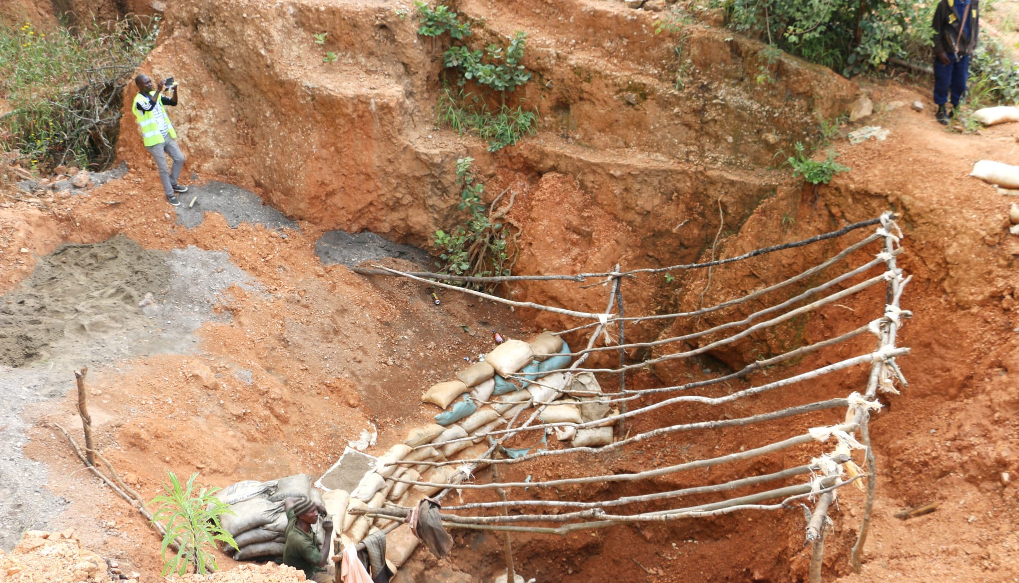
The New York Times has delved into the details of this battle, which takes us to the Kisanfu region, a forested area in the southeast of the Democratic Republic of Congo, home to one of the largest and purest untapped cobalt reserves on the planet. This African country alone accounts for more than 70% of the world’s cobalt production.
China versus the United States
The American newspaper’s investigation was based on a thousand diplomatic documents, in addition to more than a hundred interviews with people spread across three continents.
A pivotal year emerges: 2016. That year, Freeport-McMoRan, an American mining company, sold two massive cobalt reserves to the Chinese conglomerate China Molybdenum. This acceleration of the Chinese presence in Congolese mines coincided with the launch, in 2015, of the “Made in China 2025” strategy. This ambitious plan detailed China’s objectives to become a “manufacturing superpower” in ten areas, including batteries for electric vehicles.
Chinese mining companies have since embarked on a buying spree in the region, locking down a large part of the global cobalt supply chain. According to The New York Times , 15 of the 19 cobalt-producing mines in the Democratic Republic of Congo are now owned by Chinese companies. They have received at least $12 billion in loans and financing from state-backed institutions. The five largest Chinese companies in Congo, which are largely state-owned, have received at least $124 billion in credit for their international operations.
The United States has lagged behind. During his presidency, Donald Trump eliminated environmental standards for automakers, giving China even more leeway. Joe Biden’s arrival in power has coincided with renewed environmental ambitions in the United States. The new administration is currently negotiating hard with Congress to pass the “Build Back Better” bill, a $1.75 trillion spending program intended to enable America to triumph in both the fight against climate change and against Chinese competition.
Analysts and experts are already warning of the risk of a battery shortage for electric vehicles, which could disrupt supply chains, similar to the semiconductor crisis . In the United States, electric vehicle manufacturers like Tesla and traditional brands like General Motors and Ford are preparing to significantly increase their demand for cobalt and lithium in the coming years. General Motors, for example, has announced its intention to completely phase out conventional gasoline and diesel vehicles by 2035. This could severely strain already fragile reserves.
According to the National Energy Agency, supply from existing mines may only be able to cover half of the country’s lithium and cobalt needs by 2030. During a visit to a General Motors plant, Joe Biden expressed his desire to accelerate the pace of the mineral race with China, saying, ” We risked losing our advantage as a nation, and China and the rest of the world are catching up to us. Well, we’re about to turn the tide in a very, very important way .”
Europe, for its part, has fallen considerably behind in this area, even as it aims to ban the sale of new gasoline and diesel cars by 2035. A report submitted a few days ago to the French government indicates that Europe will only be able to produce 30% of its needs for strategic minerals for electric batteries by 2030. ” The European Union is clearly lagging behind China, which has gained a 20-year head start in controlling the entire supply chain of strategic minerals and metals in order to break free from dependence on fossil fuels ,” stated industrialist Philippe Varin, former CEO of PSA, and author of the report.
And in the end, it’s the Congo that pays the price.
The cobalt frenzy has attracted a significant number of opportunistic industrialists to the Democratic Republic of Congo, partly at the expense of its population. The human cost must already be considered: displaced populations, drastically reduced job security, illnesses linked to metal emissions into the air, child labor … Added to this are the environmental risks associated with mining, such as water and soil pollution. Ultimately, has the sale of these strategic resources truly benefited the African nation?
The Congo is not an isolated case. According to the China Africa Research Initiative, Chinese banks committed over $153 billion in loans to African governments and state-owned enterprises between 2000 and 2019 for infrastructure development. In return, China obtains numerous mining concessions across the continent. This relationship is tending to deteriorate due to the security, environmental, and human risks associated with Chinese projects, not to mention corruption issues. Protests have been organized against projects financed in Angola, Ghana, Kenya, and The Gambia.
Taking advantage of this unfavorable context for Beijing, the United States is now interfering in African affairs. As part of its anti-corruption program, Washington is funding the review of Chinese mining contracts in Africa . The Congolese government is on the verge of concluding a comprehensive review of its mining contracts thanks to US dollars. They are verifying whether Chinese companies are fulfilling their contractual obligations and respecting the commitments made by China as early as 2008.
The agreement was simple: in exchange for building infrastructure such as roads and hospitals for $6 billion, the Congo promised access to 10 million tons of copper and more than 600,000 tons of cobalt. However, China does not appear to have honored its part of the deal. In August, Congolese President Felix Tshisekedi appointed a commission to investigate allegations that China Molybdenum may have defrauded Congolese authorities of billions of dollars in royalties. The company risks being expelled from the Democratic Republic of Congo.
Given the lag in the US, these maneuvers will likely not be enough to catch up with China. Developed countries may still have to turn to China if they want to decarbonize their economies. With supply unable to keep pace with the current surge in demand, the semiconductor shortage that is severely impacting the automotive industry could quickly be followed by a cobalt shortage. Unless, of course, a new substitute is found by then…
Leave a Reply