Team cohesion has become a central theme for French companies since the health crisis forced them to send their employees home. Uniting teams in the context of an uncertain recovery has become critical. ” The collective spirit eroded during the lockdown ,” notes Christophe Nguyen, an occupational psychologist.
Fostering team spirit was Lunchr ‘s niche , which we told you about when it launched in early 2018. Initially focused on digitizing the meal voucher market, the FinTech startup rebranded as Swile last March. After its resounding entry into the traditional lunchtime market dominated by four players (Edenred, Natixis, Chèque-Déjeuner, and Sodexo), the company has just completed its fourth funding round in four years. With investments from BPI France, Idvinvest, and Index Ventures, Swile is showcasing its new ambitions with the €70 million raised. On the agenda: “managing all employee benefits by integrating new segments such as gift vouchers, mobility vouchers, and, starting next year, holiday vouchers,” as Swile’s founder, Loïc Soubeyrand, explains.
Building cohesion within the company by digitizing employee benefits
Tackling the number one employee benefit for the French was “the biggest challenge. We followed a classic, but accelerated, development cycle because the lunch break market was clearly ready to go digital. Two years later, we have clients ranging from startups to large corporations with over 10,000 employees .” With impressive references like Spotify and Red Bull, Swile announced last March that it had captured 7% of a market worth €6.5 billion. The lunch break is also a sacred moment in the workplace. “We knew we wanted to address team cohesion in this area that’s so popular with the French. By digitizing a rather rigid benefit, we wanted to make technology available to teams. We were convinced there was room for growth.”
Now ready to broaden its initial scope and “support employees’ daily lives from morning till night , ” Lunchr has transformed into Swile (a contraction of Smile at Work). For this rebranding, “the transition went very smoothly. Unlike meal vouchers, we already have a solid base of 8,000 clients who trust us to strengthen their team cohesion.” After lunchtime, the logical next step was to integrate the rest of the employee benefits that French employees value so highly.
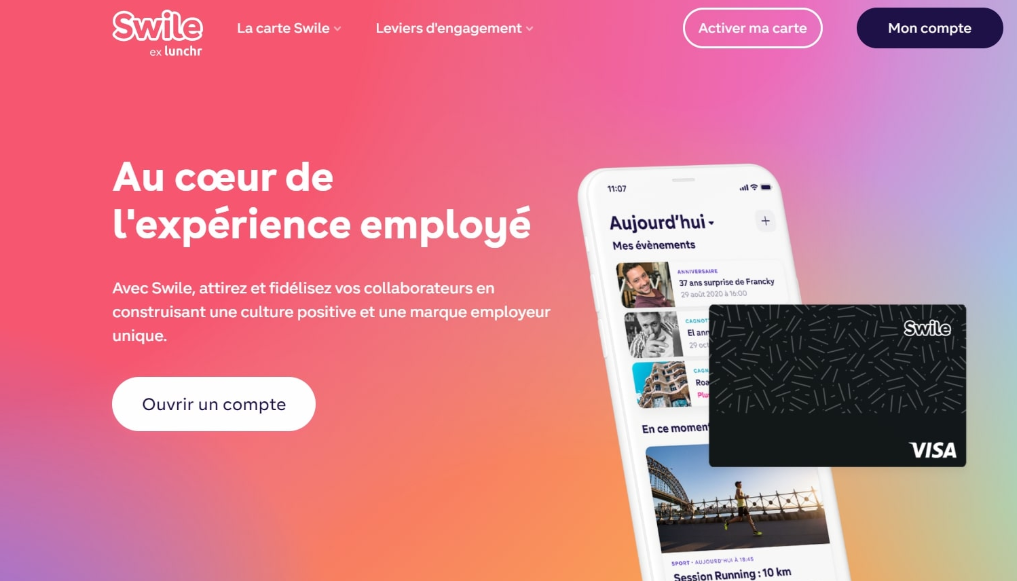
Swile, the only player to unify the management of these employee benefits, offers an app and a payment card. The principle is simple: the card is first credited by the employer, and each time the employee makes a payment to a Swile merchant network, the corresponding balance is debited. This earmarked money system “moves towards a complete simplification of the employee experience. By integrating gift vouchers and mobility vouchers, we want to make everyday life easier .” Gift vouchers will appear in the Swile catalog this fall. That’s when 80% of the market is captured.
Integrate social features and go international
In a destabilized economic environment, the CEO also observes that many companies “were absolutely unprepared to face a world where remote work is the norm. This poses a significant challenge for team cohesion.” To address this, Swile has features in development designed to tackle these challenges. From celebrating employee birthdays and team funds to internal messaging and events, the startup aims to boost social interaction. “With a Premium offering launching this fall, we want to give companies the ability to measure employee engagement: internal surveys, analytics, organizational charts… all these HR aspects will be crucial for the end of the year.”
To develop these new social features, Swile favors a homegrown approach, but keeps a close eye on the collaborative market. “Obviously, the core functionality is homegrown, and it’s intended to remain so. Beyond that, you have to think of Swile as a truly multi-layered project. There will probably be acquisitions to strengthen the offering in the future.”
The startup’s ambitions are clear. Securing such a substantial funding round in July 2020 also aligns with its internationalization strategy. The cautious economic climate doesn’t faze its founder; on the contrary: “More than ever, people will need to connect. We’re in an extremely resilient market because it makes sense.” Globally, 33 countries use this meal voucher system. Swile has specifically targeted one of them: Brazil. By launching with a “global platform that cleverly combines employee benefits and engagement, we aim to become a world leader.”
Leave a Reply