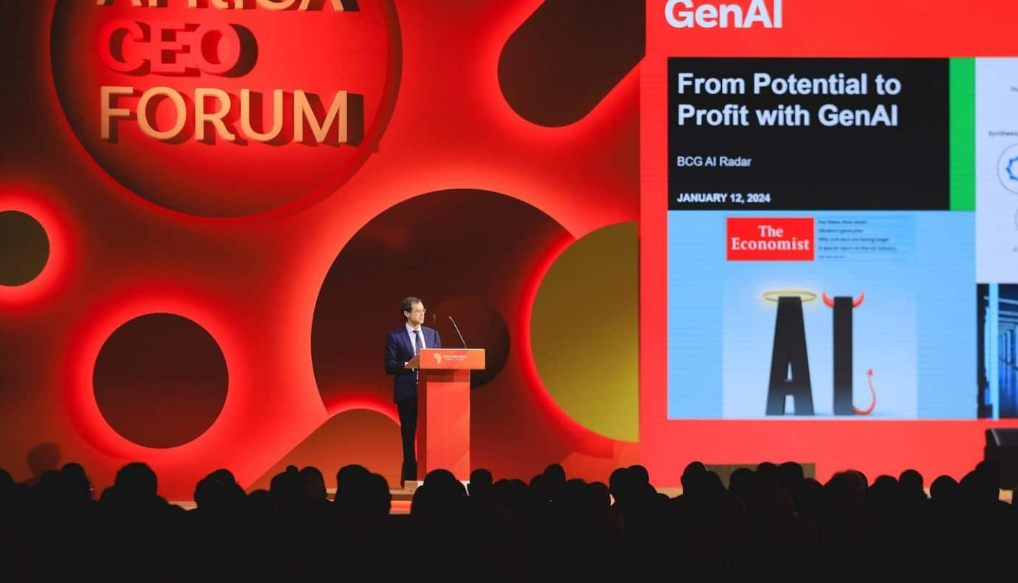
Artificial intelligence, a key topic this year, naturally found its place at the Africa CEO Forum, held in Kigali in mid-May. During this “African Davos,” as it is sometimes called, discussions about AI and how the continent can and should play a role in the sector abounded.
To be an active participant in AI rather than a passive recipient of it
“ A place at the table or on the menu? ” This is the theme of the 2024 edition of the event organized by the media outlet Jeune Afrique . In his introductory speech, Amir Ben Yahmed, creator of this meeting of some 2,000 political and economic leaders from the continent, explained this choice: Africa must take its rightful place and command respect in international exchanges, at the risk of ending up “ on the menu of global economic competition .”
This issue becomes particularly relevant in the context of AI. Last year, Kenyan moderators working for a former OpenAI subcontractor mobilized to protest their working conditions. They were exposed daily to violent and shocking content for $1.46 to $3.74 an hour, in order to train the models of the industry leader .
This situation illustrates how Africa can remain ” on the menu ” of AI, with low-paying, difficult jobs requiring few skills. Naturally, the ambition at the Africa CEO Forum was to demonstrate how the continent can and must have its rightful place ” at the table .”
From the opening ceremony, Tawfik Hammoud, a member of the global executive committee of the consulting firm BCG, used his speaking time to praise AI. He emphasized this readily available opportunity for productivity gains and contributions to sectors such as education and healthcare.
Several initiatives and successes were highlighted, such as the opening of specialized AI training programs in the Maghreb and the recent acquisition of the Tunisian startup InstaDeep for €600 million by the pharmaceutical giant BioNTech. Its co-founder, the Franco-Tunisian Karim Beguir, is among the winners of the TIME100 AI Impact ranking for his model capable of detecting new variants of Covid-19.
Another prominent figure from the continent to feature in TIME’s list of the most influential people in AI is Kate Kallot, co-founder and CEO of the Kenya-based startup Amini. At the Forum, she made no secret of the challenges that must be overcome to make the continent a significant player in AI.
Africa needs to complete its digital transition; AI can help.
From a purely technical standpoint, two major challenges immediately come to mind: the need for infrastructure and the lack of data. This latter point is crucial for developing AI models that are truly adapted to African culture.
During a discussion at the Africa CEO Forum, the businesswoman shared a personal anecdote to illustrate her point: ” I asked ChatGPT, ‘What is the national dish of the Central African Republic?’ and the answer was ‘nyembwe chicken,’ when in fact it’s the national dish of Gabon .” Alex Okosi, Google’s managing director for Africa, who was also on stage, seized the opportunity to suggest, amid laughter, that they look to his company’s model, Gemini.
This issue of the cultural relevance of AI models is not unique to Africa. These models are primarily trained using English and Anglo-Saxon sources. When the newspaper Le Monde announced its agreement with OpenAI to allow ChatGPT to be trained on its content, the leading French media outlet rightly pointed out that its articles would make the French-language results more relevant .
The other major barrier standing between AI and Africa featured prominently in many of the speeches at the event. Heads of state, ministers, business leaders, international organizations, startups… all emphasized the need to improve the continent’s digital infrastructure.
As evidenced by the proliferation of multi-billion dollar data centers worldwide , AI requires this type of infrastructure. Africa is not entirely devoid of data centers; Alex Okosi is quick to point out that Google recently established a region in South Africa. However, the continent remains far less equipped than others.
More generally, despite having the highest internet traffic growth in the world, there is still a long way to go to complete Africa’s digital transformation. AI, provided it fully embraces this shift, is presented as a way to make progress in this direction.
Leave a Reply