Category: Blog

Your blog category

  • Amazon’s media division is estimated to be worth $500 billion.

    Amazon’s media division is estimated to be worth $500 billion.

    On June 16, Needham’s team published an analysis of Amazon’s stock. They 
    estimate that the company’s media division represents $500 billion in hidden asset value, almost as much as the company’s cloud division, AWS, valued at $560 billion.

    “Twitch is the most undervalued asset in the Amazon empire.”

    According to Laura Martin, an analyst at Needham, 20% of Amazon Prime subscribers subscribe less for fast delivery than for the accompanying offers. Based on 2020 revenue, Prime subscriptions generated $187 billion, music $3.8 billion, Twitch $15 billion, and advertising $127 billion. The remaining $170 billion or so needed to reach $500 billion represents this so-called “hidden value.”

    Higher margins than online commerce, data sources, brand presence in homes – Laura Martin is enthusiastic about Amazon’s media sector, and particularly about Twitch: ”  
    Twitch is the most undervalued asset in the Amazon empire (in our opinion) because it allows Amazon to extend its reach to the next generation of shoppers. Similarly, Amazon Music extends the reach of the Amazon demo into the home  .”

    In the long term, the share price could reach $5,000

    The firm specifies that a subsidiary, if independent of Amazon, would be 1.5 times less valuable. The key is to integrate into Jeff Bezos’s company strategy, gain a foothold, and then expand. Laura Martin explains that ”  Amazon’s data superiority, economies of scale, and brand franchises generate additional revenue for any company owned by Amazon compared to what that company could generate as a standalone entity  .”

    Based on these various observations, Needham estimated that the target price for an Amazon share was $3,200 (it is currently $2,640). Laura Martin believes that in the long term, the share could be worth up to $5,000 due to these hidden values. This year, Amazon’s share price has increased by 42%, bringing it to a record market capitalization of $1.3 trillion . If Needham’s analysis is to be believed, this growth is unlikely to stop.

  • “We want to boost team cohesion,” says Loïc Soubeyrand, CEO of Swile.

    “We want to boost team cohesion,” says Loïc Soubeyrand, CEO of Swile.

    Team cohesion has become a central theme for French companies since the health crisis forced them to send their employees home. Uniting teams in the context of an uncertain recovery has become critical. ”  The collective spirit eroded during the lockdown ,” notes Christophe Nguyen, an occupational psychologist.

    Fostering team spirit was Lunchr ‘s niche , which we told you about when it launched in early 2018. Initially focused on digitizing the meal voucher market, the FinTech startup rebranded as Swile last March. After its resounding entry into the traditional lunchtime market dominated by four players (Edenred, Natixis, Chèque-Déjeuner, and Sodexo), the company has just completed its fourth funding round in four years. With investments from BPI France, Idvinvest, and Index Ventures, Swile is showcasing its new ambitions with the €70 million raised. On the agenda: “managing all employee benefits by integrating new segments such as gift vouchers, mobility vouchers, and, starting next year, holiday vouchers,” as Swile’s founder, Loïc Soubeyrand, explains.

    Building cohesion within the company by digitizing employee benefits

    Tackling the number one employee benefit for the French was “the biggest challenge. We followed a classic, but accelerated, development cycle because the lunch break market was clearly ready to go digital. Two years later, we have clients ranging from startups to large corporations with over 10,000 employees .” With impressive references like Spotify and Red Bull, Swile announced last March that it had captured 7% of a market worth €6.5 billion. The lunch break is also a sacred moment in the workplace. “We knew we wanted to address team cohesion in this area that’s so popular with the French. By digitizing a rather rigid benefit, we wanted to make technology available to teams. We were convinced there was room for growth.”

    Now ready to broaden its initial scope and “support employees’ daily lives from morning till night  , ” Lunchr has transformed into Swile (a contraction of Smile at Work). For this rebranding, “the transition went very smoothly. Unlike meal vouchers, we already have a solid base of 8,000 clients who trust us to strengthen their team cohesion.” After lunchtime, the logical next step was to integrate the rest of the employee benefits that French employees value so highly.

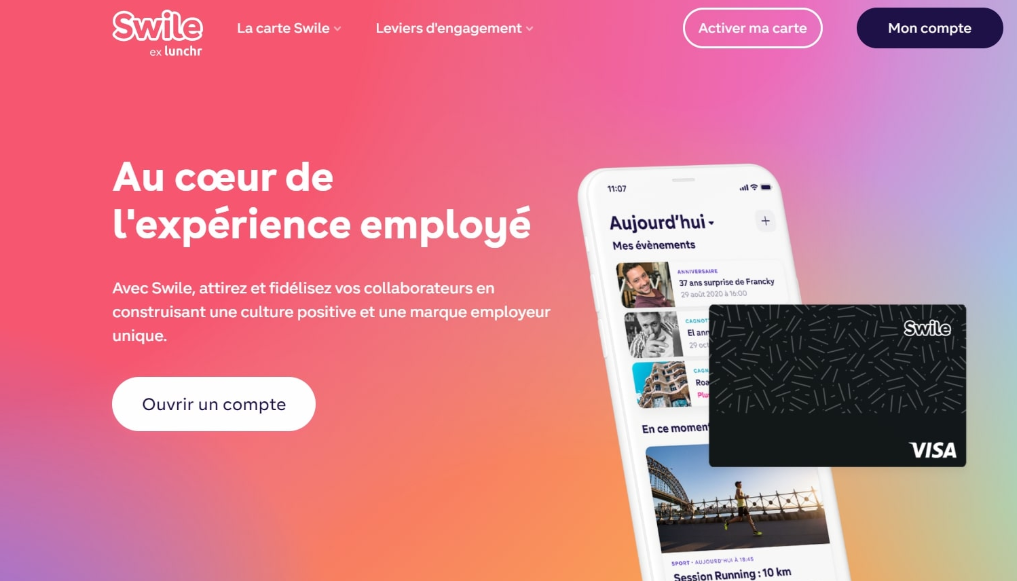
    Swile, the only player to unify the management of these employee benefits, offers an app and a payment card. The principle is simple: the card is first credited by the employer, and each time the employee makes a payment to a Swile merchant network, the corresponding balance is debited. This earmarked money system “moves towards a complete simplification of the employee experience. By integrating gift vouchers and mobility vouchers, we want to make everyday life easier .” Gift vouchers will appear in the Swile catalog this fall. That’s when 80% of the market is captured.

    Integrate social features and go international

    In a destabilized economic environment, the CEO also observes that many companies “were absolutely unprepared to face a world where remote work is the norm. This poses a significant challenge for team cohesion.” To address this, Swile has features in development designed to tackle these challenges. From celebrating employee birthdays and team funds to internal messaging and events, the startup aims to boost social interaction. “With a Premium offering launching this fall, we want to give companies the ability to measure employee engagement: internal surveys, analytics, organizational charts… all these HR aspects will be crucial for the end of the year.”

    To develop these new social features, Swile favors a homegrown approach, but keeps a close eye on the collaborative market. “Obviously, the core functionality is homegrown, and it’s intended to remain so. Beyond that, you have to think of Swile as a truly multi-layered project. There will probably be acquisitions to strengthen the offering in the future.”

    The startup’s ambitions are clear. Securing such a substantial funding round in July 2020 also aligns with its internationalization strategy. The cautious economic climate doesn’t faze its founder; on the contrary: “More than ever, people will need to connect. We’re in an extremely resilient market because it makes sense.” Globally, 33 countries use this meal voucher system. Swile has specifically targeted one of them: Brazil. By launching with a “global platform that cleverly combines employee benefits and engagement, we aim to become a world leader.”

  • Fintech: Investors reduce risks as the COVID-19-induced slowdown continues

    Fintech: Investors reduce risks as the COVID-19-induced slowdown continues

    In its latest report, “Fintech Funding Roundup, Q2 2020,” Forrester provides an overview of fintech funding by venture capital firms, investors, and financial institutions. The COVID-19 pandemic and its economic impact have not spared the fintech sector.

    Worst quarter since 2018 with 6.34 billion in financing

    Harmed by the economic climate, Fintech funding experienced significant growth over the last decade, rising from $1 billion in 2010 to $39 billion in 2019. The year 2020 promises to be different, with a sharp decline in investments. Already observed in the first quarter of 2020, the drop accelerated in the second.

    In these challenging months, it’s worth noting that the American payment provider Stripe still managed to raise $600 million in April, while the Brazilian online bank Nubank raised $300 million. Forrester also points out that “the impact of the crisis continues to vary across geographic regions: China recorded no transactions for the second consecutive quarter.”

    Another effect of the crisis is that the fintechs attracting investment are those in advanced stages and focused on large funding rounds, considered safer. Thus, 52% of funds went to late-stage startups , while the 21 companies that secured $100 million or more in funding accounted for nearly 65% ​​of the total funding for the entire quarter.

    A concentration of funds towards digital banks, lenders and payment service providers

    The investment trend in fintech is confirmed: money is flowing to mature, established, and well-used technology sectors. Investors are therefore favoring fintech companies that improve existing processes.

    Stripe is a good example. With its $600 million Series G funding round (totaling $1.6 billion for a valuation of $36 billion), the company fits perfectly into the trend of improving online payment processes, a trend that itself reflects the ongoing migration from cash to digital payments. In another study , Forrester highlighted the shift in payment practices accelerated by the COVID-19 crisis, as cash is perceived as unhygienic, leading consumers to turn to e-commerce. Forrester also points out that Stripe’s example is not unique; Checkout.com raised $150 million in its latest funding round, bringing its valuation to $5.5 billion.

    Fintech companies that capitalize on crisis dynamics by providing solutions to consumer needs are also attracting investors. At the intersection of investor concerns and responses to public needs, neobanks are thriving. Nubank, mentioned earlier, which now boasts 20 million account holders, reacted swiftly during the COVID-19 pandemic by distributing government relief payments and providing loans to vulnerable individuals impacted by the crisis. Further north, the American online bank Varo Money raised $241 million in Series D funding while supporting its customers by providing rapid access to government assistance measures.

    The same logic applies to fintech companies that support very small and small businesses. Public funding amplifies investment in companies that provide solutions to the COVID-19 crisis that has hit small businesses hard. Forrester cites the example of Judo Bank, specializing in business loans and banking services, which secured the largest fintech funding in the second quarter with $649 billion, including funds from several branches of the Australian government.

    Another trend is that established fintech players are acquiring others to expand, for example, the American online personal finance company SoFi was bought for 1.2 billion by Galileo, a payment software company.

    A tough future and consolidation for fintech

    The impact of the COVID-19 pandemic has been severe for fintech companies and is far from over. The landscape is shifting, with a more secure outlook for fintechs that have secured significant funding and/or possess sufficient capital. The Forrester report offers some predictions for the fintech sector.

    In times of crisis, some fintech companies that have directly challenged traditional banks will be at risk. As funding dries up and the outlook shows no sign of improvement, defaults will increase, according to the report, and only a few leaders are expected to emerge. With this difficulty facing fintech companies, banks will see opportunities arise for “cheap acquisitions.”

    Tech giants and other large non-bank companies will continue to show increasing interest in fintech. The GAFA companies have already begun acquiring or financing fintech firms, and banks are increasingly wary of players like Amazon and Apple, which could become leading players in financial services. Forrester points out that, without capturing huge market share, these companies’ investments in fintech will drive up costs, making it more difficult for traditional banks to acquire innovative digital services at low prices.

    Finally, back-office automation will accelerate. This area, which is reaching a certain level of maturity, should increasingly replace manual tasks performed by bank employees, allowing banks to reduce costs. Those banks that invest or make relevant acquisitions will thus be able to remain competitive with the GAFA companies and the leading fintech firms.

  • Mexico: the next El Dorado for Chinese electronics manufacturers?

    Mexico: the next El Dorado for Chinese electronics manufacturers?

    Foxconn , Pegatron, and other major Taiwanese manufacturers are considering establishing operations in Mexico to avoid being caught in the crossfire of the trade war between the United States and China. This is confirmed 
    by sources directly involved in these new locations. Foxconn already has five facilities in Mexico, all located in Juárez, as is Pegatron.

    Beyond this commercial battle, the various impacts of Covid-19 are a second motivation for manufacturers to get closer to their customers. As the sole assembler of iPhones in the world and directly affected, Foxconn has had to slow down production, as well as exports. This consequence will very likely delay the release of the iPhone 12, or 
    at least the supply to Apple Stores worldwide.

    One person’s misfortune is another’s gain, and the arrival of new industries in Mexico is a boon for the country. Its economy has been so severely impacted by the pandemic that it is expecting its worst recession in 80 years. If Foxconn, Pegatron, and similar companies establish production facilities, several hundred billion pesos will flow into the state coffers, creating thousands of jobs. The Taiwanese giant is expected to finalize its decision before the end of the year, and production would be primarily dedicated to smartphones.

    While Foxconn’s partners directly involved in these projects are not clearly identified, the United States is a likely target. Juárez’s location is also significant. Situated on the border with the United States, supplying all 48 contiguous states becomes child’s play compared to maritime freight from China. Mexico has also highlighted other advantages, such as low wages and shared time zones with its neighbor.

    From a factory city in Shenzhen, China, employing several hundred thousand people, Foxconn is gradually relocating its production. Currently, 30% of its products are assembled outside of China. While Mexico is obviously an attractive country for various reasons, the giant recently participated in a project to develop infrastructure in India , alongside Samsung.

    Other companies are also pushing to leave China, such as Google, which wants to produce its Pixel smartphones in Vietnam . On the manufacturing side, Luxshare Precision Industry, the main manufacturer of AirPods for Apple, is also eyeing Mexico. So, we can expect to see products ” designed by Apple in California  ,” but made in Mexico.

  • This map reveals the most funded European tech startups.

    This map reveals the most funded European tech startups.

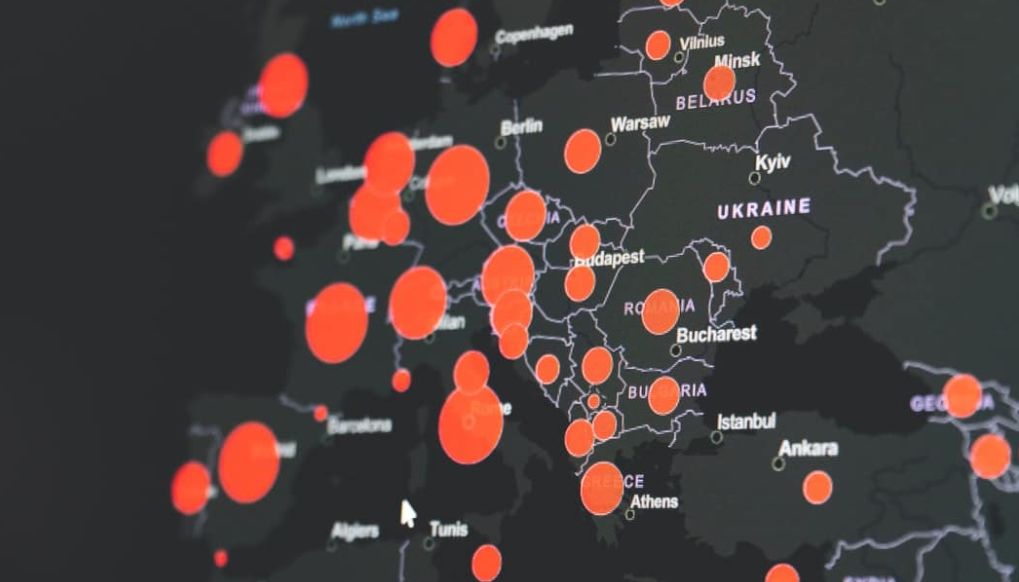
    The data analytics consultancy CB Insights has released a map of the European startups that have received the most funding . The map identifies, for each European country, the startup that has raised the most money.

    The firm points out that since 2015, $90 billion has been invested in European tech startups . Looking at the leading startup in each country, the cumulative amount stands at almost $9.2 billion (as of February 3, 2020).

    OneWeb, Klarna and N26 are among the top three startups that have raised the most funding.

    At the top of the European podium is the British satellite operator OneWeb , having raised over $3.4 billion. The startup had attracted the attention of many European observers in recent months after the coronavirus crisis severely impacted its operations, leading it to file for bankruptcy at the end of March. The international operator had set itself the goal of bringing internet access to the entire world through the launch of a constellation of mini-satellites . Five years after its initial fundraising rounds, the company founded by Greg Wyler filed for bankruptcy on March 27, but hoped to attract interest from potential buyers. This wish was granted in early July when a surprising Anglo-Indian partnership announced its acquisition of OneWeb.

    More recently, N26 also made headlines for 
    issues related to labor law compliance in Germany. 
    An internal conflict between management and employees had been simmering for several months 
    at the company’s headquarters . At issue was 
    the creation of a works council, a proposal championed by N26 employees. Challenged by management on the grounds that it would hinder the company’s agility, the initiative took a legal turn. After a vote by show of hands, 
    the works council was ultimately approved and, barring any unforeseen circumstances, should be established soon.

    Hooray! The 
    French representative for CB Insights’ mapping service is none other than 
    BlaBlaCar . 
    The carpooling app has raised $449 million – and despite record losses during the lockdown (less than 1% of its activity) – can count on a much more promising summer season than anticipated. Its CEO, Nicolas Brusson, explained on 
    BFM Business that 
    passenger demand is up 15% compared to last year . The French startup also took advantage of the lockdown to 
    launch BlaBlaHelp, a neighborhood help app .

  • Uber’s next business venture? Bank loans for drivers.

    Uber’s next business venture? Bank loans for drivers.

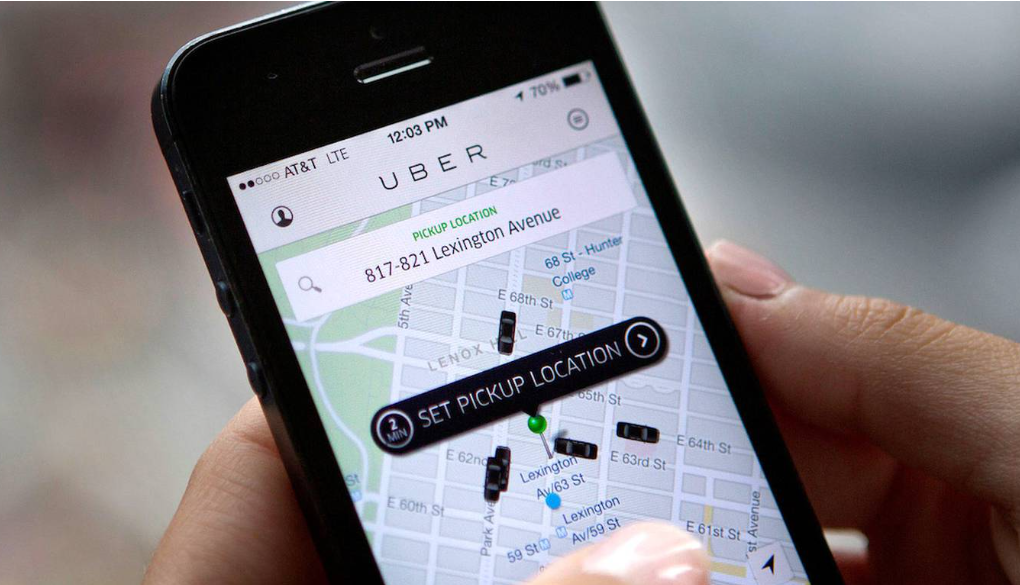
    Uber is no longer just a ride-hailing service. The company has more than one idea for 
    diversification , and it seems the banking sector is of interest. The company is preparing a financial product for drivers, which would take the form of a loan, as noted by 
    Recode.

    A financial product is being prepared

    Several drivers have noticed a survey appearing on their app. Created by Uber, it contains various questions about loans. For example, the company asks about “the most important factors when deciding whether to take out a loan,” whether drivers have ever taken out small loans (less than $1,000), and how likely they would be to take out a loan with Uber if offered the option.

    With this loan, the company aims to help drivers “in times of need.” Drivers would, of course, not be obligated to take out loans. Nothing is official from Uber. This survey may seem innocuous, but the idea of ​​this financial product is not surprising. Uber has already offered similar programs to some drivers in certain states in the United States. The company also offers solutions to help drivers obtain a car quickly, through 
    partnerships with rental companies, for example .

    Uber’s actions are being criticized.

    However, the company’s initiative, if it comes to fruition, risks being heavily criticized. Uber and other companies like Lyft are accused of underpaying drivers. Furthermore, the two American leaders could soon be required to reclassify independent contractor contracts as employee contracts if the bill is passed by the Senate. To combat this, the two companies have proposed implementing a minimum wage of approximately $21 per hour for drivers completing a ride.

    The loans could be seen as short-term salary advances. This type of loan is a real trend in the United States. Companies like Walmart offer them to help their employees and also to increase their productivity. Uber declined to comment, and the rather strong reactions will certainly force the company to reconsider this project and prepare it thoroughly if an official launch is to take place.

  • Uber claims to have the cash to weather the coronavirus crisis

    Uber claims to have the cash to weather the coronavirus crisis

    This is a major blow for Uber, which had hoped to 
    reach profitability by the end of 2020. The coronavirus crisis and the resulting lockdown measures 
    are already having a significant impact on the ride-hailing company’s business . On March 19, its CEO, Dara Khosrowshahi, attempted to reassure the public.

    Uber’s business has been severely impacted by the crisis

    The lockdown measures are impacting the entire economy, and transportation companies in particular. In the United States, spending on Uber fell by 20% in just one week. In the cities hardest hit by the virus, such as Seattle, Los Angeles, and New York, there were 70% fewer trips.

    Several measures have been taken: the Uber Pool feature, which allowed users to travel more cheaply with strangers on similar routes, has been removed. The $150 million marketing and incentive budget has been cut. In the United States, according to Les Échos , a message appears when the app is opened: ”  Only travel if necessary. Help flatten the curve  .”

    A message that, strangely, doesn’t appear on the French version of Uber. France currently has nearly 11,000 cases, while the United States has just over 14,250. This message seems minimal given the seriousness of the situation, but Uber is simultaneously facing a worrying stock market situation.

    Uber shares fall, Khosrowshahi reassures investors

    The stock market impact was immediately felt. Between February 20, the company’s peak performance, and March 18, Uber’s stock lost approximately 64% of its value. This is undoubtedly what prompted Dara Khosrowshahi to speak out.

    He explained to investors, ”  We are very fortunate to have a strong cash position with approximately $10 billion in unrestricted liquidity at the end of February  .” This news may seem surprising given that Uber has never had a profitable quarter.

    The ride-hailing company’s teams modeled an extreme scenario of an overall 80% reduction in the number of rides until the end of the year. According to their projections, Uber would have $4 billion in cash reserves and $2 billion in revolving credit.

    Furthermore, the CEO emphasized that Uber Eats’ business was booming, stating, ” Our Eats business is a vital resource right now, especially for restaurants that have been impacted by lockdown measures  .” In France, while restaurants are closed except for delivery services, it’s still possible to see Uber Eats delivery drivers on the streets.

    All of these announcements seem to have slightly reassured investors, as the shares have recovered some ground to stabilize around 50% of their value on February 20.

    And what about the drivers?

    For drivers, who are particularly exposed to the risk of infection, financial assistance is available in the event of a confirmed case of COVID-19 or mandatory quarantine. This is an important message, given that Uber drivers are officially considered independent contractors. This status will likely change in France, since shortly before the crisis, the Court of Cassation ruled in favor of a driver , declaring him an employee of the ride-hailing company.

  • Cobalt: The post-oil era caught in a battle between the United States and China

    Cobalt: The post-oil era caught in a battle between the United States and China

    As the climate emergency forces major nations to rethink their carbon emission strategies, a new battle is raging over resources intended to replace oil. Among them is cobalt, a mineral essential for battery production, at the heart of the race to electrify the automotive industry. For now, this competition is largely dominated by 
    China . The Middle Kingdom has taken advantage of the opening created by years of American policies favoring internal combustion engine vehicles. Today, Washington’s priorities have changed—but is it too late?

    The New York Times investigated the struggle between China and the United States over land in the Democratic Republic of Congo to gain control of the largest share of the world’s cobalt resources. At the expense of the local population, of course.

    Cobalt: the new black gold

    One of the main applications of cobalt today is in the manufacture of rechargeable batteries of all kinds. Cobalt improves the performance of batteries in smartphones, connected devices, and laptops, and plays a significant role in electric vehicles. With this resource being finite and the needs of the technology industries exploding, the Worldwide Power Company predicts a shortage by 2030, or even 2025 according to more pessimistic forecasters.

    For example, a long-range Tesla requires approximately 10 kilograms of cobalt, more than 400 times the amount found in a mobile phone. Manufacturers such as Ford are striving to limit the need for newly mined cobalt by turning to recycling and/or reducing the proportion of this precious mineral in favor of other metals. This strategy has its limitations; for the moment, it is not possible to completely replace it.

    China , well aware of the stakes, took advantage of the lack of competitors to seize a large share of production at the expense of the United States, which was too busy promoting internal combustion engine vehicles. The latter, now focusing on electric vehicle sales as part of its new environmental policy, wants to regain control over cobalt production. The dominance of its major Chinese rival in this mineral risks driving up prices and crowding out American electric vehicle production in favor of its own.

    The New York Times has delved into the details of this battle, which takes us to the Kisanfu region, a forested area in the southeast of the Democratic Republic of Congo, home to one of the largest and purest untapped cobalt reserves on the planet. This African country alone accounts for more than 70% of the world’s cobalt production.

    China versus the United States

    The American newspaper’s investigation was based on a thousand diplomatic documents, in addition to more than a hundred interviews with people spread across three continents.

    A pivotal year emerges: 2016. That year, Freeport-McMoRan, an American mining company, sold two massive cobalt reserves to the Chinese conglomerate China Molybdenum. This acceleration of the Chinese presence in Congolese mines coincided with the launch, in 2015, of the “Made in China 2025” strategy. This ambitious plan detailed China’s objectives to become a “manufacturing superpower” in ten areas, including batteries for electric vehicles.

    Chinese mining companies have since embarked on a buying spree in the region, locking down a large part of the global cobalt supply chain. According to The New York Times , 15 of the 19 cobalt-producing mines in the Democratic Republic of Congo are now owned by Chinese companies. They have received at least $12 billion in loans and financing from state-backed institutions. The five largest Chinese companies in Congo, which are largely state-owned, have received at least $124 billion in credit for their international operations.

    The United States has lagged behind. During his presidency, Donald Trump eliminated environmental standards for automakers, giving China even more leeway. Joe Biden’s arrival in power has coincided with renewed environmental ambitions in the United States. The new administration is currently negotiating hard with Congress to pass the “Build Back Better” bill, a $1.75 trillion spending program intended to enable America to triumph in both the fight against climate change and against Chinese competition.

    Analysts and experts are already warning of the risk of a battery shortage for electric vehicles, which could disrupt supply chains, similar to the semiconductor crisis . In the United States, electric vehicle manufacturers like Tesla and traditional brands like General Motors and Ford are preparing to significantly increase their demand for cobalt and lithium in the coming years. General Motors, for example, has announced its intention to completely phase out conventional gasoline and diesel vehicles by 2035. This could severely strain already fragile reserves.

    According to the National Energy Agency, supply from existing mines may only be able to cover half of the country’s lithium and cobalt needs by 2030. During a visit to a General Motors plant, Joe Biden expressed his desire to accelerate the pace of the mineral race with China, saying, ” We risked losing our advantage as a nation, and China and the rest of the world are catching up to us. Well, we’re about to turn the tide in a very, very important way .”

    Europe, for its part, has fallen considerably behind in this area, even as it aims to ban the sale of new gasoline and diesel cars by 2035. A report submitted a few days ago to the French government indicates that Europe will only be able to produce 30% of its needs for strategic minerals for electric batteries by 2030. ”  The European Union is clearly lagging behind China, which has gained a 20-year head start in controlling the entire supply chain of strategic minerals and metals in order to break free from dependence on fossil fuels ,” stated industrialist Philippe Varin, former CEO of PSA, and author of the report.

    And in the end, it’s the Congo that pays the price.

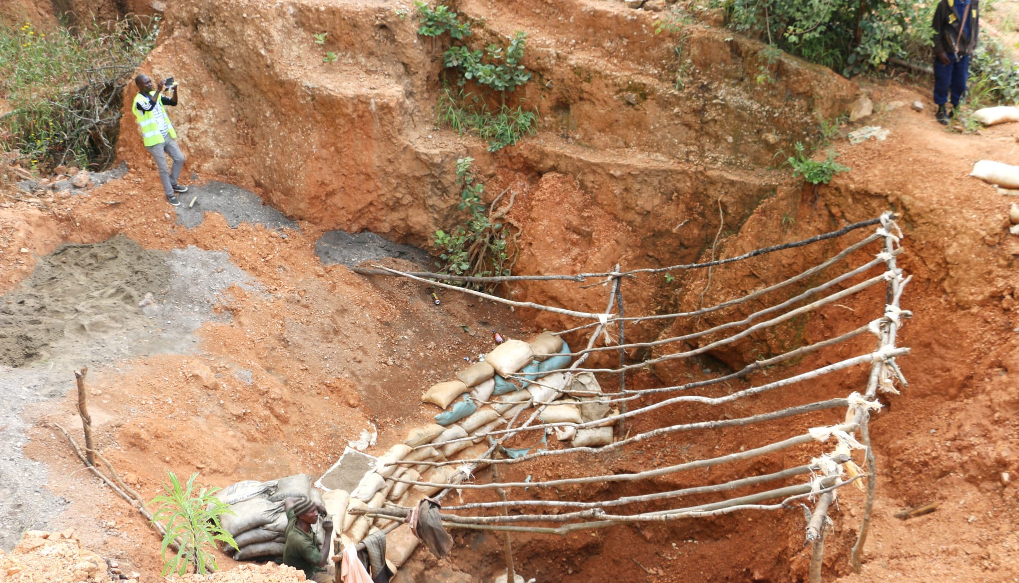
    The cobalt frenzy has attracted a significant number of opportunistic industrialists to the Democratic Republic of Congo, partly at the expense of its population. The human cost must already be considered: displaced populations, drastically reduced job security, illnesses linked to metal emissions into the air, child labor … Added to this are the environmental risks associated with mining, such as water and soil pollution. Ultimately, has the sale of these strategic resources truly benefited the African nation?

    The Congo is not an isolated case. According to the China Africa Research Initiative, Chinese banks committed over $153 billion in loans to African governments and state-owned enterprises between 2000 and 2019 for infrastructure development. In return, China obtains numerous mining concessions across the continent. This relationship is tending to deteriorate due to the security, environmental, and human risks associated with Chinese projects, not to mention corruption issues. Protests have been organized against projects financed in Angola, Ghana, Kenya, and The Gambia.

    Taking advantage of this unfavorable context for Beijing, the United States is now interfering in African affairs. As part of its anti-corruption program, Washington is funding the review of Chinese mining contracts in Africa . The Congolese government is on the verge of concluding a comprehensive review of its mining contracts thanks to US dollars. They are verifying whether Chinese companies are fulfilling their contractual obligations and respecting the commitments made by China as early as 2008.

    The agreement was simple: in exchange for building infrastructure such as roads and hospitals for $6 billion, the Congo promised access to 10 million tons of copper and more than 600,000 tons of cobalt. However, China does not appear to have honored its part of the deal. In August, Congolese President Felix Tshisekedi appointed a commission to investigate allegations that China Molybdenum may have defrauded Congolese authorities of billions of dollars in royalties. The company risks being expelled from the Democratic Republic of Congo.

    Given the lag in the US, these maneuvers will likely not be enough to catch up with China. Developed countries may still have to turn to China if they want to decarbonize their economies. With supply unable to keep pace with the current surge in demand, the semiconductor shortage that is severely impacting the automotive industry could quickly be followed by a cobalt shortage. Unless, of course, a new substitute is found by then…
  • Africa’s digital transition faces an infrastructure challenge

    Africa’s digital transition faces an infrastructure challenge

    In mid-March, more than fifteen African countries experienced disruptions to their 
    internet access . The disruptions ranged from poor connectivity to complete internet blackouts. The cause was a simple accident: the rupture of several submarine cables off the coast of Ivory Coast.

    While this type of incident is not uncommon, the consequences here were significant. Africa is indeed connected to the rest of the world via submarine cables, but these are too few in number to offer sufficient resilience, unlike in other regions.

    According to figures put forward by Aminata Ndiaye, Orange’s regional vice-president for the Middle East and Africa, only 16% of the continent’s Internet traffic remains there compared to 27% for Europe, ” being connected to the world remains essential for Africa ,” she concludes to explain the scale of the event .

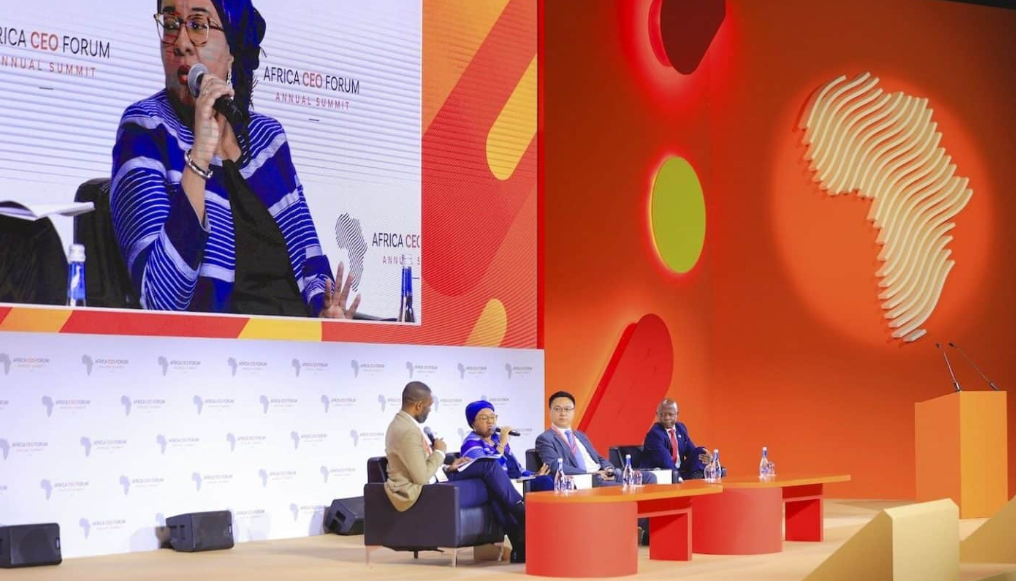
    The issue was raised in numerous speeches at the Africa CEO Forum organized in May by the media outlet Jeune Afrique . Paul Kagame, President of Rwanda, the host country for this 2024 edition, alluded to it. He illustrated the persistent digital divide between Africa and the rest of the world. Even when isolating the Global South, the continent appears particularly far behind in a sector presented as a key driver of growth.

    The lack of infrastructure remains glaring in Africa

    “ Africa experienced the fastest growth in international bandwidth usage during the 2017-2022 period, with a compound annual growth rate (CAGR) of 51%, ” explained Gregor Theisen, McKinsey’s managing partner for Africa, using a PowerPoint presentation. “ Africa is currently the continent where internet traffic is increasing the most, ” added Aminata Ndiaye.

    Submarine cables, fiber optics, and data centers have been developing rapidly across the continent over the past decade. Today, tech giants are financing these installations, seeking to capture a market widely perceived as highly promising. This momentum accelerated during the Covid period and remains strong, despite a recent slowdown.

    This catch-up digitization, however, is still accompanied by significant gaps and disparities. Africa, often underestimated in cartographic representations, is a continent with 54 countries in widely varying situations. There is a disparity between the ten largest economies on the continent and the 30% of states experiencing conflicts of various kinds.

    These disparities are glaringly obvious when it comes to the internet. 570 million of the continent’s 1.4 billion inhabitants use it. According to 2023 figures from the International Telecommunication Union, 57% of individuals living in urban areas use the internet, compared to 23% in rural areas. The same disparity exists between genders, with 42% of men using it, compared to 32% of women.

    Internet access is difficult to provide, as many regions lack basic infrastructure. In 2021, 567 million people in sub-Saharan Africa lacked access to electricity. During a discussion among presidents following the Africa CEO Forum, the President of Mozambique, Filipe Nyusi, revealed that 60% of his country was in this situation. He observed that under these conditions, a genuine digital transformation is difficult to envision.

    After access to the Internet, the use of the Internet

    The effects of this lack of digital and other infrastructure are reflected in various statistics on internet access: only 50% of the African population has access to 4G. Today, smartphones are by far the preferred means of accessing the internet. Globally, 88% of the population has access to 4G.

    There are many barriers to access, but just as many to usage. The cost of internet is on average 30 to 35% higher in Africa compared to the United States. At the same time, 60% of the world’s people living in extreme poverty—that is, earning less than $1.90 a day—are concentrated on the continent.

    According to estimates from the International Finance Corporation (IFC), the arrival of new cables, which will increase bandwidth sixfold by 2027 compared to 2022, would reduce the price of broadband internet by 10 to 11%.
    This decrease, which the international organization, a member of the World Bank Group, notes is smaller than previously projected. It also indicates that the construction of the mid- and last-mile infrastructure would require $6 billion in investment annually.

    The ICF, a partner of the Africa CEO Forum, took advantage of this international gathering to unveil its latest report, “Digital Opportunities in Business.” In this report, the institution, which specializes in supporting the private sector in developing countries, notes that 86% of African businesses have access to the internet. However, only 24% make intensive use of it in their operational functions.

    Several factors have been identified; the infrastructure deficit has already been mentioned, as well as the price of internet access. Regarding the “additional costs associated with internet,” it should be added that equipment is 35% more expensive than elsewhere, software is 20% more expensive, and skilled labor is 2.2 times more expensive. Access to financing is another issue, as the continent is currently experiencing a difficult economic situation. Finally, regulations and trade barriers complete this picture.

    On this point, Aminata Ndiaye, joined by Tonny Bao, Huawei’s vice president, argues ” for stable taxes and regulations .” This is a typical demand from private companies. The French telecommunications group and the Chinese equipment manufacturer justify this request by citing their ” long-term investments .”

    Alongside the two industrialists, Mmusi Kgafela, Botswana’s Minister of Trade and Industry, advocated for greater harmonization of regulations among African countries regarding the digital economy and facilitating the movement of talent, following the European Union model. The African Union is already working on projects of this kind through the Policy and Regulation Initiative for Digital Africa (PRIDA) and the African Continental Free Trade Area (AfCFTA).

    Makhtar Diop, CEO of the ICF, explains that ” Research shows that digitalization can foster growth in productivity, employment, exports, and income, as well as contribute to poverty reduction .” McKinsey projects 3.2 million jobs, a 1 to 2 percentage point increase in GDP by 2028, and a doubling of productivity on productivity—these are the figures put forward by McKinsey regarding the impact of digital transformation in Africa. At the press conference accompanying the IFC study, Susan Lund, the organization’s Vice President for Economics and Private Sector Development, stated that this transformation is a ” journey ” before developing, adding, ” It has taken time everywhere in the world, and it is taking time in Africa too .”

  • From Taiwan to the United States, the semiconductor industry faces drought

    From Taiwan to the United States, the semiconductor industry faces drought

    Chips burst onto the media scene in the early 2020s. A shortage of 
    these essential components for all electronic products brought car factories to a standstill and made game consoles and smartphones difficult to access. This scarcity has various causes: Covid-19, international tensions… and climate change.

    Semiconductors rather than agriculture?

    Three years ago, Taiwan experienced its worst drought in 56 years. Paradoxically, the island is one of the wettest places on Earth, receiving roughly twice as much rainfall as Finistère, France. However, unlike Brittany, Taiwan relies heavily on three or four seasonal typhoons for its water supply. By 2021, none of these weather events had occurred for two consecutive years, leading to critically low reservoir levels. Taipei was forced to impose water rationing on its two main industries: agriculture, traditionally the most water-intensive sector, and semiconductor manufacturing.

    Its flagship company in the sector, the Taiwan Semiconductor Manufacturing Company (TSMC), alone supplies 90% of the world’s advanced chips. The 36,000 km² island provides 18% of the semiconductors in circulation globally. This commercial dominance has taken on a geopolitical dimension  : several local political leaders believe it protects against a Chinese invasion. This is referred to as the “silicon shield,” silicon being the raw material for the majority of these electronic components. Furthermore, when drought forced water conservation, a report by the UN Institute for Environment and Human Security noted that ” although both sectors experienced rationing measures, the semiconductor industry clearly took priority over rice production .”

    Water is a major issue for industry. A recent report by S&P Global estimates that water scarcity in the coming decades will pose a serious threat. The semiconductor sector has enormous needs; ” globally, chip manufacturers already consume as much water as Hong Kong, a city of 7.5 million inhabitants ,” notes S&P.

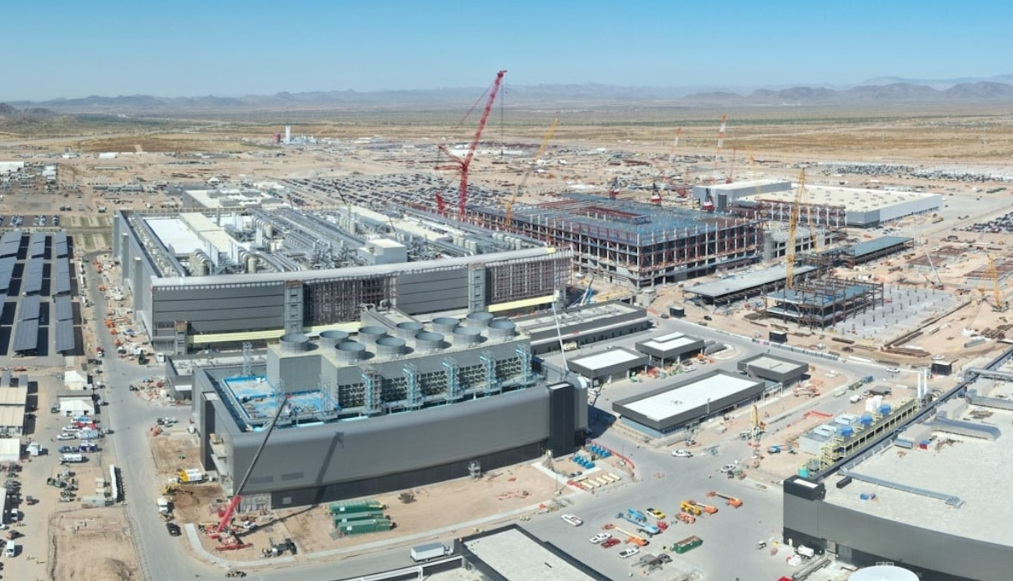
    This demand stems from the requirement to manufacture chips in ultra-clean environments. The slightest particle can ruin a production run. To avoid this, manufacturing takes place in cleanrooms where the air is 10,000 times purer than in an operating room. To clean all the tools and materials used in the process, artificially pure water, produced by the companies, is necessary. The resource also has more traditional industrial uses, such as cooling energy-intensive installations or “cleaning” toxic gases.

    In Taiwan, 2021 saw the deployment of tanker trucks at the entrances to scientific campuses housing semiconductor “fabs.” The industry nevertheless had to slow its consumption by 15%, exacerbating the ongoing global shortage.